
Dónde establecer tu imperio digital: Estonia vs. Irlanda vs. Portugal vs. Chipre
En la economía global de hoy, establecer una ubicación para tu negocio digital, ya sea una Consultoría de TI, una plataforma SaaS o una agencia dedicada de desarrollo web—es una de las decisiones estratégicas más críticas. Europa ofrece un mosaico de jurisdicciones, cada una prometiendo ventajas únicas en fiscalidad, facilidad de constitución, acceso a talento y cumplimiento normativo.
Elegir el país equivocado puede generar dolores de cabeza innecesarios en cuanto a cumplimiento, facturas de impuestos más altas y un crecimiento más lento. Esta guía completa compara cuatro de las jurisdicciones más populares y competitivas de Europa para emprendedores digitales en 2026: Estonia, Irlanda, Portugal y Chipre.
Desglosaremos los factores cruciales que debes considerar para encontrar el hogar óptimo para tu negocio digital europeo.
ES Comparación de jurisdicciones: factores clave para negocios digitales
Las empresas digitales priorizan cuatro factores principales al seleccionar una ubicación: Eficiencia fiscal, Facilidad para hacer negocios (Digitalización), Complejidad del cumplimiento, y Acceso a Talento/Mercado.
| Característica | Estonia (La pionera digital) | Irlanda (El Imán de Gigantes Tecnológicos) | Portugal (El Hub Nómada) | Chipre (La Isla Amiga de los Impuestos) |
| Impuesto de sociedades sobre beneficios no distribuidos | 0% (Modelo de reinversión único) Impuesto de defensa 2% sobre los beneficios contables (2026-2028), deducible en caso de distribuciones) | 12,51 TP3T (estándar); 151 TP3T (mínimo). Solo para grandes multinacionales con ingresos superiores a 750 millones de euros. | 21% (Estándar) / 17% (Pymes/Startups en los primeros 25 000 €) | 12,51 TP3T (estándar) |
| Digitalización y Facilidad de Configuración | De primer nivel (Residencia electrónica, totalmente digital) | Alto (eficaz, pero menos digital que el EST) | Moderado (Mejorando, requiere notario) | Moderado (Requiere presencia física para cuenta bancaria) |
| Impuesto sobre los dividendos | 22/78 | 25% (Retención estándar; exenciones en virtud de convenios o de la Directiva sobre sociedades matrices y filiales) | 28% (tarifa plana) | 0% (Condición de no residente) / 17% (GESY) |
| Talento y I+D | ExcelenteFintech/GovTech (enfoque) | ExcelenteSede mundial (presencia) | Bueno (en crecimiento Nómada digital comunidad | Moderado (Fuerte Marítimo/Finanzas (enfoque) |
| Lo mejor para | Arranque de empresas emergentes, Comercio electrónico, Sociedades holding | Respaldado por capital de riesgo Escalados, EE. UU./Reino Unido Acceso al mercado | Agencias Pequeñas, Traslado | Forex/Cripto, Estructuras de retención, Gestión de patrimonios |
1. Estonia: El Pionero Digital y paraíso fiscal para el crecimiento
Estonia es, posiblemente, la jurisdicción europea más favorable para fundadores centrados puramente en la reinversión y la expansión internacional. Su principal atractivo es la e-Residencia programa, que permite a los no residentes gestionar una empresa de forma remota, convirtiéndolo en el el país más fácil para iniciar una empresa en Europa para emprendedores digitales.
La ventaja fiscal: Impuesto de sociedades 0%
El sistema fiscal de Estonia es revolucionario y una de las principales razones por las que a menudo se cita en las discusiones sobre mejor país de Europa para negocios SaaS.
- 0% Impuesto sobre Sociedades (IS) sobre las ganancias no distribuidas: Este es el cambio de juego. Solo pagas CIT (a un tipo del 22/78) cuando distribuyes ganancias como dividendos. Mientras reinviertas las ganancias en tu empresa de TI o de desarrollo, la tasa impositiva es efectivamente cero.
- A partir del 1 de enero de 2026, se aplicará un “impuesto de defensa” temporal de 2%” se aplica a los beneficios contables (antes de las distribuciones), pero es deducible a efectos del impuesto sobre sociedades, exime los dividendos ya gravados en el extranjero (con una participación ≥10%) y expira tras 2028, lo que hace que la reinversión siga siendo muy eficiente desde el punto de vista fiscal para la mayoría de las empresas digitales.
- Facilidad para cumplir con la normativa: La infraestructura digital no tiene parangón. La presentación de declaraciones de impuestos, la firma de documentos y la gestión de cuentas se pueden realizar en línea, lo que reduce los gastos administrativos.
Consideración clave
Aunque el impuesto sobre el rendimiento del capital (0%) es fantástico para el crecimiento, el impuesto sobre los dividendos (aprox. 22%) se paga a nivel de la empresa. Esto podría resultar menos ventajoso que en otras jurisdicciones si tu objetivo es obtener beneficios de forma inmediata.
Artículo relacionado: Cómo iniciar una empresa en Estonia: Guía paso a paso
2. Irlanda: El Centro Corporativo para la Escala Global
Irlanda se ha posicionado con éxito como la puerta de entrada europea líder para los gigantes tecnológicos mundiales. Para una Empresa de SaaS Si buscas obtener capital de riesgo (VC) importante o acceder a los lucrativos mercados de EE. UU. y el Reino Unido, una sociedad limitada irlandesa suele ser la opción predeterminada.
La Ventaja Fiscal: Baja Tasa Estatutaria
- 12.5% Impuesto sobre Sociedades: Este tipo impositivo reducido, reconocido a nivel mundial, junto con la amplia red de convenios de doble imposición de Irlanda, ofrece previsibilidad y coherencia a las grandes empresas con elevados ingresos. Fuente: El impuesto de sociedades en la República de Irlanda
- Beneficios de las Sociedades Holding: Irlanda es un lugar muy atractivo para la gestión de la propiedad intelectual (PI), gracias a su sólido marco jurídico y a la exención de impuestos sobre las plusvalías derivadas de la venta de acciones en filiales que cumplan los requisitos.
Consideración clave
Los costes de constitución y mantenimiento en Irlanda son considerablemente más elevados que en jurisdicciones como Estonia o Chipre. La carga administrativa es mayor y, aunque el tipo impositivo del 12,51 % es bajo, no es cero en beneficios no distribuidos, lo que puede ralentizar la reinversión en las primeras etapas.
3. Portugal: la mejor opción para los fundadores nómadas digitales
Portugal se ha convertido rápidamente en uno de los destinos favoritos entre Fundadores de agencias de desarrollo y consultores informáticos a distancia debido a sus atractivas opciones de visa y a incentivos fiscales especializados para individuos. Si bien la tasa impositiva corporativa es más alta, los beneficios personales pueden convertirla en una opción óptima para empresarios que planean reubicarse.
La ventaja fiscal: incentivos para empresas emergentes y el NHR
- Reducción del impuesto de sociedades: Las pequeñas y medianas empresas (pymes) y las empresas emergentes pueden beneficiarse de un tipo impositivo reducido del impuesto de sociedades del 17% sobre los primeros 50 000 € de beneficio imponible, lo cual resulta competitivo para las pequeñas empresas.
- IFICI / “NHR 2.0” (Incentivo fiscal para la investigación científica y la innovación): El régimen original de Residente No Habitual (RNH) está completamente cerrado a nuevos solicitantes a partir de 2024-2025. Ha sido reemplazado por el régimen IFICI, que ofrece un tipo impositivo fijo del 20,1 % en el impuesto sobre la renta de las personas físicas sobre los ingresos por cuenta ajena o por cuenta propia procedentes de Portugal, en el caso de actividades de alto valor añadido que cumplan los requisitos (por ejemplo, desarrollo de software, I+D, startups certificadas, investigación científica). A diferencia del antiguo NHR, los dividendos de origen extranjero, las plusvalías y los ingresos pasivos no están automáticamente exentos y, por lo general, se gravan a los tipos progresivos estándar (hasta el 48,3 % + recargo de solidaridad) o a un tipo fijo del 28,3 % en el caso de los dividendos.
- Retención fiscal sobre los dividendos: 28% (puede reducirse mediante convenios de doble imposición o mediante el uso de una estructura de sociedad holding portuguesa).
Consideración clave
- El impuesto de sociedades es ahora más alto que en Estonia, Irlanda o Chipre después de 2026 para la mayoría de las empresas digitales.
- El nuevo régimen IFICI es más restrictivo y burocrático que el anterior NHR; ya no es una amplia “solución fiscal para nómadas digitales”. Funciona mejor si te reubicas, creas empleo local o si tu actividad se certifica como de alto valor/innovadora.
- La constitución de empresas y el cumplimiento normativo continuo aún requieren visitas notariales y pasos físicos con más frecuencia que en Estonia; la digitalización completa está mejorando pero aún no a niveles bálticos.
- Portugal sigue siendo excelente para el estilo de vida y el acceso a talento de la UE, especialmente con la Visa de Nómada Digital D8 (ingresos mínimos de 3.480 €/mes en 2025-2026) y un camino relativamente sencillo hacia la residencia permanente.
Artículo Relacionado: ¿Qué necesitas saber para crear una LLC en Portugal?.
4. Chipre: La Isla Fiscal Estratégica del Mediterráneo
Chipre es a menudo pasado por alto por los emprendedores digitales, pero es muy competitivo, especialmente para las empresas involucradas en Forex, Criptomonedas y estructuras de tenencia sofisticadas. Ofrece una de las tasas de impuesto sobre la renta corporativa estatutaria más bajas de la UE y reglas excepcionales para personas de alto patrimonio neto.
La Ventaja Fiscal: Estatus de No Domiciliado y Régimen de Propiedad Intelectual
- 12.5% Impuesto sobre Sociedades: Una tarifa muy competitiva y estable dentro de la UE. A partir del 1 de enerode será una tarifa fija de 15%.
- Estatus de No Residente Fiscal (Non-Dom): Un cambio radical para fundadores que se mudan. Los residentes no domiciliados que cumplan los requisitos exento de impuestos sobre los dividendos y los ingresos pasivos por intereses, lo que hace que la extracción de beneficios sea muy eficiente.
- Régimen de Caja de IP Este incentivo permite una exención 80% sobre los beneficios que cumplan los requisitos y que se generen a partir de activos de propiedad intelectual (por ejemplo, código de software, marcas registradas), lo que podría reducir el tipo impositivo efectivo sobre los beneficios derivados de la propiedad intelectual hasta un mínimo de 2.5%. Esto es extremadamente atractivo para un Negocio de SaaS o desarrollo de software que posee una PI valiosa.
Consideración clave
Chipre es geográficamente menos central que Irlanda o Estonia, y su sistema bancario puede ser objeto de un intenso escrutinio, requiriendo una diligencia debida exhaustiva durante el proceso de apertura de cuentas.
Relacionado: Los países más económicos de Europa para iniciar un negocio.
Preguntas frecuentes
¿Cuál es el mejor país de Europa para bajas tasas impositivas corporativas para empresas de TI?
A: Estonia es el ganador claro en beneficios retenidos con su 0%: Impuesto sobre la renta (CIT) sobre los beneficios reinvertidos. Si tu objetivo es principalmente el impuesto sobre las ganancias pagadas, Chipre es muy competitivo, con un tipo impositivo sobre sociedades del 12,51 % y 0%: impuesto sobre la renta de las personas físicas por dividendos para residentes no domiciliados.
P2: ¿Puedo iniciar una empresa de SaaS en Europa sin ser residente?
A: Sí. Programa de e-Residencia de Estonia está diseñado específicamente para esto. Puedes incorporar una empresa, gestionar la banca y firmar documentos desde cualquier lugar del mundo, lo que lo convierte en la opción más eficiente para fundadores no pertenecientes a la UE.
P3: ¿Qué país europeo es el mejor para un desarrollador nómada digital?
A: Portugal es óptimo para el desarrollador individual o el propietario de una pequeña agencia que planea mudarse, debido a su Visa de Nómada Digital y los beneficios fiscales que ofrece el régimen de Residente No Habitual (RNH).
Conclusión: Encontrando el Hogar Europeo Óptimo para tu Negocio Digital
No existe un único “mejor” país; solo existe el que mejor se adapta a la etapa específica de tu negocio y a tus objetivos personales:
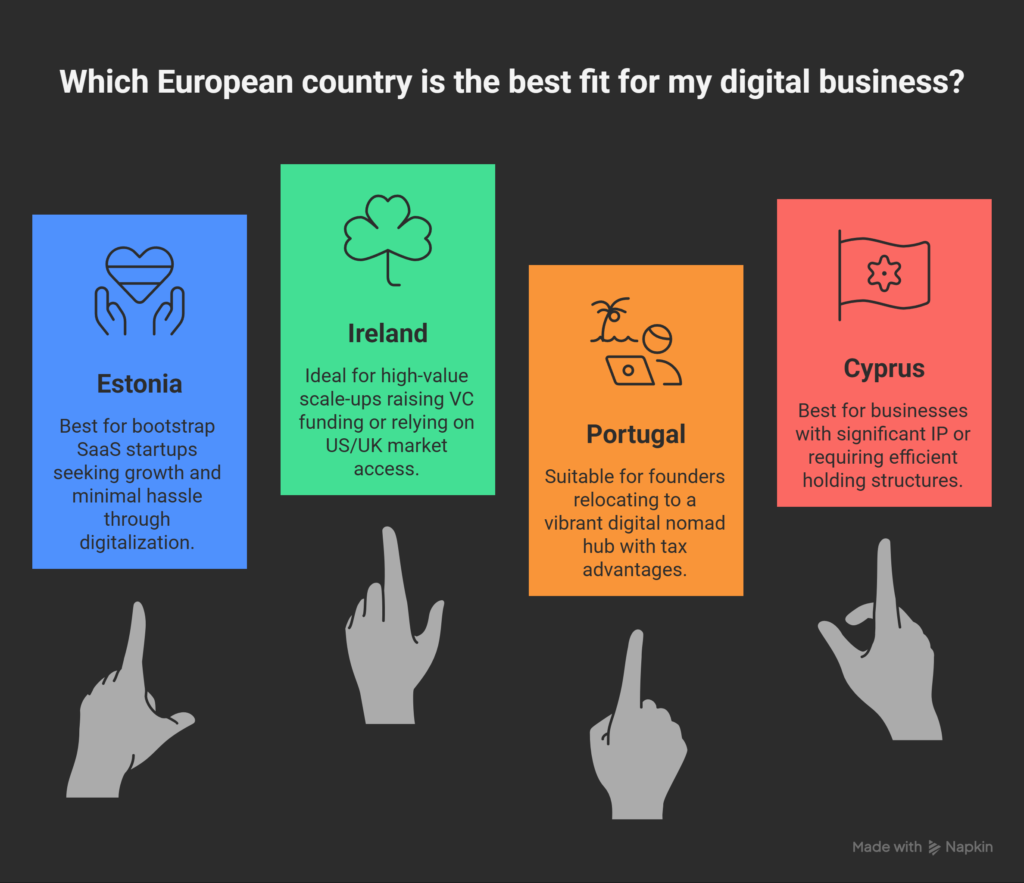
- Elige Estonia (e-Residencia): Si tu objetivo principal es maximizar el crecimiento, reinvertir el 100 % de los beneficios y reducir al mínimo las molestias administrativas mediante una digitalización sin igual, esta es la mejor país para startups SaaS bootstrapped.
- Elige Irlanda: Si eres una scale-up de alto valor, que principalmente recauda grandes sumas de Financiamiento de capital de riesgo, o si tu estrategia de acceso al mercado depende en gran medida de las relaciones con Estados Unidos/Reino Unido.
- Elige Portugal Si eres un fundador o un equipo pequeño activamente buscando reubicar a un vibrante, cálido y altamente conectado centro para nómadas digitales con ventajas fiscales personales.
- Elige Chipre: Si estás dirigiendo un negocio con un impacto significativo propiedad intelectual (IP) o requieren una estructura de tenencia de alta eficiencia con extracción óptima de dividendos (estatus Non-Dom).
Cómo Helvetios.eu Puede Ayudarle a Empezar
Navegar por las complejidades de la legislación fiscal internacional, los requisitos de residencia y las obligaciones de cumplimiento en estas cuatro jurisdicciones distintas es un trabajo a tiempo completo. Como agencia de consultoría internacional especializada, Helvetios tu socio de confianza para establecer y gestionar tu negocio digital europeo.
Proporcionamos guía clara y confiable y apoyo profesional en cada paso:
- Formación de empresas: Desde registrar tu OÜ estonio a través de la e-Residencia hasta completar los pasos notariales necesarios para tu LDA portuguesa.
- Banca Corporativa: Guiamos a no residentes a través del riguroso proceso de apertura de cuentas bancarias corporativas en estas jurisdicciones, incluidas áreas de alta supervisión como Chipre e Irlanda.
- Optimización fiscal Nuestros expertos asesoran sobre cómo establecer la estructura adecuada para beneficiarse legalmente de 0% CIT en Estonia o el Caja IP en Chipre, asegurando que minimices tu tasa impositiva corporativa efectiva.
- Ayuda para la reubicación: Para fundadores que se mudan a Portugal o Chipre, ayudamos con los permisos de residencia y los pasos necesarios para asegurar incentivos fiscales personales como el NHR o el estatus de No Residente.
No dejes que las regulaciones complejas frenen tu crecimiento. Programe hoy mismo una consulta con los expertos en formación de empresas internacionales de Helvetios para determinar su base europea óptima..