
In the fast-moving world of European tech, your most valuable asset isn’t your office or your hardware—it’s your Intellectual Property (IP). Whether you are building an AI-driven SaaS or a niche dev tool, where that IP “lives” legally can determine whether you scale with your own profits or lose a third of your growth capital to the taxman.
As we navigate 2026, the two heavyweights of the European digital economy (Estonia and Cyprus) offer two radically different strategies for IP management. This guide breaks down which jurisdiction wins for your specific business model.
What is Intellectual Property (IP) in 2026?
Before diving into tax law, we must define the asset. In the context of an IT or SaaS business, Intellectual Property refers to the intangible creations of the mind that give your business its competitive edge.
In 2026, this primarily includes:
- Software Code & Algorithms: The core backend and frontend logic of your platform.
- Copyrighted Material: Design assets, UI/UX elements, and proprietary documentation.
- Trademarks: Your brand identity, logos, and product names.
- Patents: Unique technological innovations (e.g., a specific method for data encryption).
Under the EU’s “Nexus Approach,” tax benefits are no longer just about where a company is registered—they are tied to where the Research and Development (R&D) actually happens.
Estonia: The “Growth Box” for Reinvestment
Estonia remains the gold standard for e-residents and digital nomads. It is defined by its radical simplicity: a “cash-flow” tax system where profit itself is not taxed—only the distribution of that profit is.
The 2026 Tax Landscape in Estonia
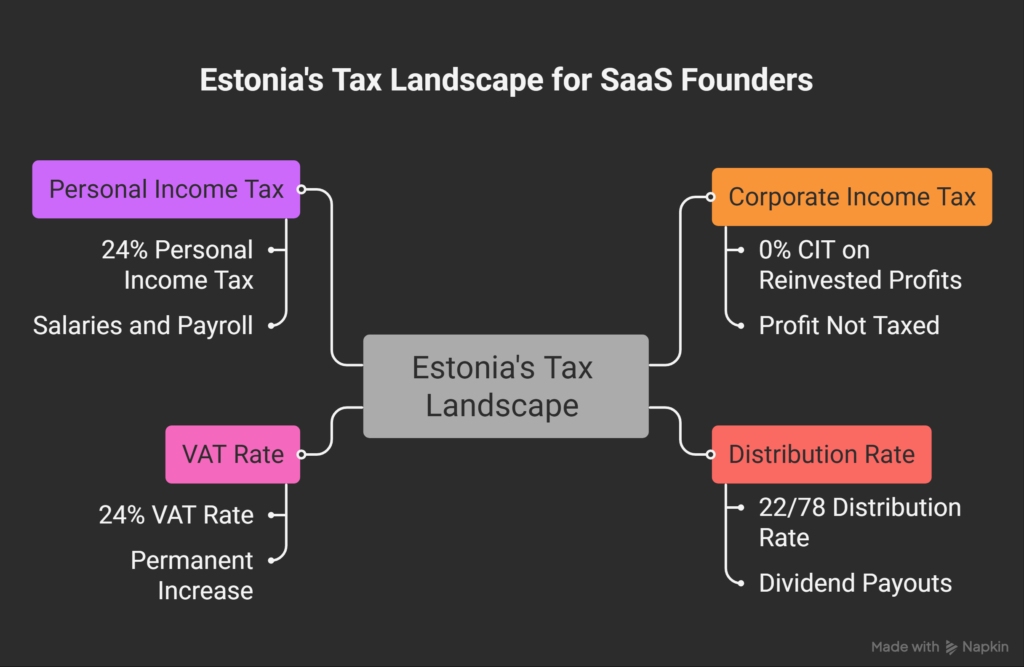
As of January 1, 2026, there are two key updates every founder must know:
- The 0% Corporate Income Tax (CIT) on Reinvested Profits: This is unchanged. As long as your SaaS keeps its money in the company bank account to hire more developers or buy ads, you pay zero tax.
- The 22% Distribution Rate: If you decide to pay yourself a dividend in 2026, the tax rate has shifted to 22/78 (effectively 22% of the gross amount).
- VAT Increase Becomes Permanent: Estonia has also confirmed that the standard VAT rate will remain at 24% starting from July 1, 2025. Initially introduced as a temporary defense-related measure, the increase is now permanent. This affects SaaS companies selling taxable services within Estonia, as well as operational expenses, subscriptions, software tools, and agency services purchased locally. Because naturally the subscription economy needed another subscription, this time to geopolitics.
- Personal Income Tax Increase: From 2026, personal income tax will increase from 22% to 24%. Founders paying salaries to themselves or employees should account for slightly higher payroll-related costs and lower net income for employees.
Despite these increases, Estonia continues to remain one of the most attractive jurisdictions in Europe for SaaS founders thanks to its digital infrastructure, transparent tax system, e-Residency ecosystem, and the ability to defer corporate taxation indefinitely while reinvesting profits.
Best For: Bootstrap startups, small teams, and companies that want to reinvest 100% of their earnings into growth without the overhead of complex accounting.
Related: Register an LLC Company in Estonia
Cyprus: The “IP Box” Powerhouse
While Estonia focuses on the flow of money, Cyprus focuses on the source of the money. Cyprus offers the IP Box Regime, a specialized tax incentive designed specifically for companies that own and exploit high-value software and patents.
The 3% Effective Tax Rate
In 2026, Cyprus increased its standard Corporate Tax to 15% (aligning with global OECD standards). However, the IP Box remains its “secret weapon”:
- 80% Deemed Deduction: If your profit comes from “Qualifying IP” (like copyrighted software), Cyprus allows you to treat 80% of that profit as a tax-deductible expense.
- The Math: You only pay the 15% tax on the remaining 20% of your profit.
$1,000,000 Profit → 80% Exemption ($800k) → 15% Tax on $200k = $30,000 Total Tax (3%).
The “Substance” Catch
Unlike Estonia, where you can be a 100% remote founder via e-Residency, Cyprus requires Substance. To claim the 3% rate in 2026, you generally need:
- A physical office in Cyprus.
- To demonstrate that the R&D or management of the IP is happening on the island.
- To follow the Nexus Ratio (if you outsource your R&D to non-EU companies, your 3% rate may be diluted).
Best For: Scale-ups with over €200k in annual profit, companies with valuable proprietary algorithms, or founders looking to relocate to a Mediterranean tech hub.
Head-to-Head: Which one should you choose?
| Feature | Estonia (OÜ) | Cyprus (Ltd) |
| Tax on Reinvested Profit | 0% | 3% – 15% |
| Tax on Distributed Dividends | 22% | 0% (for Non-Dom residents) |
| Management Style | 100% Digital / e-Residency | Requires local “Substance” |
| Best For | Early-stage / Bootstrapping | High-profit SaaS / IP Sales |
| IP Protection | EU Standard | EU Standard + specialized IP Box |
Why Strategy Matters for 2026 and Beyond
Choosing between these two isn’t just about the numbers today; it’s about your exit strategy.
If you plan to sell your SaaS in three years, holding the IP in a Cyprus Limited might make the company more attractive to buyers, as the 3% tax rate on royalties will carry over. However, if you are a solo developer who wants to live in Bali while building a “lifestyle business,” the administrative ease of Estonia is unbeatable.
For a deeper look at other European options, check out our Ultimate Guide to European Jurisdictions in 2026, which covers Portugal and Ireland as well.
Frequently Asked Questions (FAQ)
1. Does software code really count as Intellectual Property in Cyprus? Yes. Unlike some countries that only allow “Patents” in their IP boxes, the Cyprus regime explicitly includes copyrighted software. This makes it the premier choice for SaaS and App developers.
2. Can I move my IP from Estonia to Cyprus later? Yes, but it requires careful “Transfer Pricing.” You must sell the IP from the Estonian company to the Cyprus company at a fair market value. We recommend doing this early, before the valuation of your software skyrockets.
Ready to structure your digital empire?
Navigating the 2026 tax reforms requires more than a calculator—it requires a partner. At Helvetios, we specialize in helping IT and SaaS founders bridge the gap between Estonia’s digital efficiency and Cyprus’s tax optimization.