
Thinking about “Create an LLC (OÜ) in Estonia?”
Estonia has revolutionized the way entrepreneurs think about company formation. As the world’s first digital nation, this Baltic country offers something unprecedented: the ability to establish and manage a European Union company entirely online, from anywhere in the world. For entrepreneurs seeking efficient, cost-effective EU market access, the Estonian LLC (known locally as “Osaühing” or OÜ) has become the gold standard.
This comprehensive guide walks you through everything you need to know about forming an Estonian LLC, from initial requirements through ongoing compliance, and explains why this jurisdiction has become the preferred choice for thousands of international entrepreneurs.
Read related article: Estonia vs. UK: Which Jurisdiction is Best for Your Digital or Remote Business in 2025?
What is an Estonian LLC (OÜ)?
An Osaühing (OÜ) is the Estonian equivalent of a Limited Liability Company, and it’s the most popular business structure in Estonia for both local and international entrepreneurs. The OÜ provides limited liability protection, meaning shareholders are only liable up to the amount of their investment in the company.
Estonian LLCs enjoy full recognition throughout the European Union, can conduct business across all EU member states, and benefit from Estonia’s advanced digital infrastructure that allows complete remote management. This combination of legal credibility, operational flexibility, and digital convenience has made the OÜ the structure of choice for tech startups, e-commerce businesses, SaaS, consulting firms, holdings, and digital service providers worldwide.
The structure works equally well whether you’re a solo entrepreneur, a partnership, or planning to build a team. You can start small with minimal capital requirements and scale seamlessly as your business grows, all while maintaining the professional credibility that comes with being an EU-registered company.
Key Advantages of Estonian LLC Formation
Understanding why thousands of entrepreneurs choose Estonia helps contextualize the formation process. The benefits extend far beyond simple incorporation and touch every aspect of business operations.
- Advanced digital infrastructure means you can establish your company, sign documents, file taxes, manage banking, and handle all corporate obligations entirely online. Estonia’s e-Residency program gives non-residents access to the same digital government services that Estonian citizens enjoy, creating true location independence for business owners.
- Unique tax system generally defers corporate income tax on retained business profits until distribution, supporting reinvestment. Dividend distributions and certain other taxable payments, such as fringe benefits and non-business expenses, can create tax liabilities.
- EU market access provides immediate credibility and operational rights across all 27 EU member states. Your Estonian company can sell products and services, hire employees, and establish presence throughout the European Union without additional corporate structures in each country.
- International credibility comes from operating within a well-regulated EU jurisdiction. Estonian companies benefit from strong legal frameworks, transparent corporate registries, and international recognition that opens doors to partnerships, banking relationships, and business opportunities that might be challenging with less established jurisdictions.
- Straightforward compliance keeps ongoing administrative burden minimal. Estonia has streamlined reporting requirements, clear tax obligations, and digital-first processes that make annual compliance significantly easier than in most other jurisdictions.
Related articles: Simplified VAT via IOSS & Dividend Tax Relief and E-Residency in Estonia: Full Guide
Requirements for Forming an Estonian LLC (2026)
Before beginning the formation process, you need to understand what’s required. The good news is that Estonia has deliberately minimized barriers to entry while maintaining necessary regulatory standards.
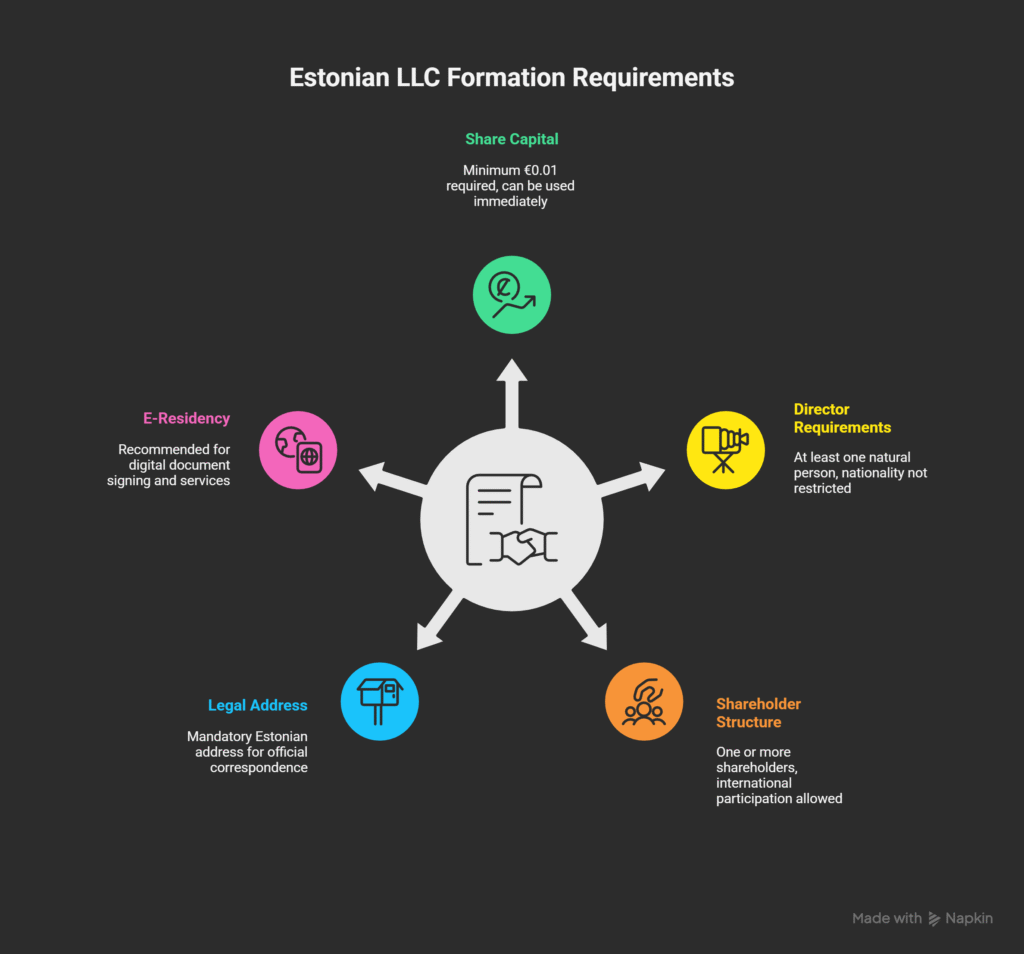
- Share capital requirement is modest at €0.01 minimum. This capital must be deposited into the company bank account.
- Director requirements mandate at least one board member who must be a natural person. This director can be of any nationality and doesn’t need to be an Estonian resident, though having an Estonian resident director can simplify certain banking and compliance matters. The director has legal responsibility for the company’s operations and compliance.
- Shareholder structure allows one or more shareholders, who can be individuals or legal entities from any country. There’s no requirement for Estonian shareholders, making this structure fully accessible to international entrepreneurs. Shareholders own the company and make major decisions, while directors handle day-to-day management.
- Legal address in Estonia is mandatory. Your company must have a registered address in Estonia where official correspondence can be received. This doesn’t need to be a physical office – many companies use virtual office services that provide a legal address, mail handling, and sometimes meeting room access.
- E-Residency is not technically mandatory for company formation, but it’s highly recommended for international entrepreneurs. E-Residency provides a digital identity card that allows you to digitally sign documents, authenticate your identity online, and access Estonia’s digital services. Without e-Residency, you’ll need to travel to Estonia or use third-party services for document signing.
The Estonian E-Residency Program: Your Digital Key
For non-residents, e-Residency is the gateway to Estonia’s digital business environment. Understanding this program is crucial before beginning your LLC formation journey.
E-Residency is not citizenship, residency, or a right to live in Estonia. Instead, it’s a digital identity issued by the Estonian government that allows secure online authentication and document signing. Think of it as your digital toolkit for managing an Estonian company remotely.
Applying for e-Residency involves submitting an online application through the official e-Residency website, providing identification documents and a photograph, paying the application fee (currently around €150), selecting a pickup location for your digital ID card, and waiting for approval, which typically takes 4-8 weeks.
Your e-Residency kit includes a smart card with embedded digital certificates, a card reader that connects to your computer via USB, and PIN codes for card access. This physical card allows you to digitally sign documents with legal validity equivalent to handwritten signatures, authenticate your identity on Estonian government platforms, and encrypt sensitive communications.
Once you have e-Residency, you can establish your company, file annual reports, sign contracts, access banking services (with additional verification), and manage all government interactions without ever setting foot in Estonia. This digital infrastructure is what makes Estonian company ownership genuinely location independent.
Step-by-Step Process: Forming Your Estonian LLC (2026)
With requirements understood and e-Residency obtained, you’re ready to establish your Estonian LLC. The process is remarkably straightforward, especially compared to company formation in most other countries.
Step 1: Choose Your Company Name
Select a unique name for your OÜ that isn’t already registered in Estonia. You can check name availability through the Estonian Business Register. The name must end with “OÜ” or “Osaühing” to indicate the legal structure. Avoid names that are misleading about your business activities or too similar to existing companies.
Consider whether you want your company name to reflect your business activities or prefer something more abstract that allows flexibility as your business evolves. Many digital businesses choose English names even for Estonian companies, as there’s no requirement for Estonian language in the company name.
Step 2: Prepare Foundation Documents
Your Estonian LLC requires several key documents: articles of association that define how your company will operate, shareholder agreements if you have multiple owners, and a decision to establish the company signed by all founding shareholders.
The articles of association must specify your company’s name and registered address, share capital amount and division, management structure and director appointment procedures, and rules for shareholder meetings and decision-making. These documents can be prepared in Estonian or English, though Estonian is required for official registry submission.
Many entrepreneurs use template documents provided by service providers, customizing them for their specific needs. While simple structures can use standard templates, more complex ownership arrangements or special provisions benefit from professional document preparation.
Step 3: Sign Documents Online or Use a Notary Where Required
A standard OÜ can be registered directly through the e-Business Register when all required parties can sign digitally and the online procedure is suitable. A separate notarisation is not automatically required because a founder is an e-resident. A notarial route may be needed if the online conditions are not met; agree the procedure and fees with the notary. See the official online registration steps.
For a notarial registration, the notary checks the required documents and signatures. Notary fees depend on the transaction and are quoted separately; they should not be presented as a compulsory extra charge for every online incorporation.
Step 4: Register with the Estonian Business Register
Submit the digitally signed application and foundation documents through the e-Business Register when using the online route. Under a notarial route, the notary handles the relevant submission. The application includes the company’s articles, founders, management board and registered address details.
The Business Register reviews submissions for legal compliance, enters your company into the public registry, and issues your company registration number. Processing typically takes 1-5 business days if all documents are correct.
Upon approval, your company officially exists as a legal entity. Your company details become publicly searchable in the Business Register, including ownership structure, director information, and registered address.
Step 5: Open a Business Bank Account
With registration complete, you need to deposit the share capital and establish banking relationships. This step has become more complex in recent years due to international banking regulations but remains entirely manageable.
Estonian banks and international fintech providers offer business accounts for Estonian companies. You’ll need to provide company registration documents, director identification, beneficial owner information, business plan or activity description, and proof of registered address.
Many banks now conduct video verification calls to satisfy Know Your Customer (KYC) requirements. Be prepared to explain your business model, expected transaction volumes, and the source of your initial capital. The account opening process typically takes 2-6 weeks depending on the institution and complexity of your business.
Once approved, you deposit the €0.01-2,500 share capital, which you can then use for business expenses. This capital payment finalizes your company formation, and you can begin operations immediately.
Read related articles:
Step 6: Register for Taxes
Your newly formed OÜ must be registered with the Estonian Tax and Customs Board. This registration covers corporate income tax, VAT (if applicable based on revenue thresholds), and social tax for employees if you plan to hire.
Most companies conduct this registration online through the e-Tax portal using their e-Residency card. You’ll specify your business activities using EMTAK codes (Estonia’s classification system), indicate expected revenue levels, and provide banking information for tax payments.
VAT registration becomes mandatory when your annual turnover exceeds €40,000, though you can register voluntarily even below this threshold if beneficial for your business model.
Understanding Estonian Tax Obligations
Tax efficiency is one of Estonia’s major attractions, but you need to understand your obligations clearly.
- Corporate income tax (CIT) in Estonia is generally deferred on retained business profits. In 2026, dividends are generally taxed at 22% of the gross distribution, calculated as 22/78 of the net dividend. Fringe benefits, non-business expenses and certain other payments can also trigger tax. See EMTA guidance.
- For example, paying a €780 net dividend generally creates €220 of corporate income tax, for a total company outflow of €1,000. Genuine business expenses and investments generally do not trigger distribution tax, but salaries and directors’ fees have separate payroll and social-tax rules.
- VAT obligations generally include registration when turnover counted towards Estonia’s registration threshold exceeds €40,000 in a calendar year; cross-border transactions can create additional obligations. Estonia’s standard VAT rate is 24%. Ordinary VAT returns (KMD and KMD INF) and VAT payment are due monthly, by the 20th day of the following month, not quarterly. OSS is a separate scheme with its own reporting timetable. See the EMTA VAT calendar.
- Social tax is generally 33% on remuneration subject to Estonian social tax. The applicable country, minimum liability and exemptions depend on the employment or director relationship and social-security coverage; ownership of an OÜ alone does not create a universal salary obligation. Review salary, directors’ fees and cross-border social-security rules for your circumstances.
- Annual reporting means submitting financial statements to the Business Register. Tax returns to EMTA are separate obligations and depend on VAT registration and taxable payments; the annual report does not replace them.
Ongoing Compliance and Management
After formation, your Estonian LLC has ongoing obligations that are straightforward but must be maintained consistently.
- Annual reporting to the Business Register is due within six months after the end of the financial year. For a financial year ending on 31 December 2025, the deadline was 30 June 2026; for one ending on 31 December 2026, it is 30 June 2027. Other financial year-ends have different deadlines. See the Business Register explanation.
- Tax declarations follow the relevant taxable period. Ordinary VAT returns and payment are due by the 20th of the following month. Taxable payroll, dividends and other reportable payments are declared on TSD, generally by the 10th of the following month. Estonia does not require a general annual corporate income tax return merely because an OÜ earned profits. See EMTA’s TSD guidance.
- Bookkeeping requirements mandate maintaining accurate financial records of all transactions. While Estonia doesn’t require certified accountants for small companies, proper record-keeping is essential for tax compliance and business decision-making. Many entrepreneurs use accounting software designed for Estonian companies or outsource bookkeeping to local specialists.
- Banking and financial management requires maintaining your business account, ensuring sufficient funds for tax obligations, and keeping business and personal finances strictly separated. Regular bank reconciliation helps catch errors early and simplifies annual reporting.
- Document retention rules require keeping business records for seven years. Digital storage is accepted and encouraged, making this requirement easy to satisfy while maintaining easy access to historical information.
Common Challenges and How to Overcome Them
While Estonian LLC formation is relatively straightforward, certain challenges commonly arise. Understanding these in advance helps you navigate them smoothly.
- Banking relationship difficulties represent the most frequent challenge for new Estonian companies. International regulations have made banks more cautious, particularly with companies owned by non-residents in certain countries. To improve your chances, prepare a comprehensive business plan, demonstrate genuine business activity, start with fintech providers who are often more flexible, and consider working with service providers who have banking relationships.
- Understanding the tax system can be confusing initially, particularly the deferred taxation model and how it interacts with dividend distributions. Many entrepreneurs benefit from initial consultation with an accountant familiar with Estonian taxation to understand how the system applies to their specific business model.
- Maintaining compliance while operating remotely requires discipline and organization. Setting calendar reminders for filing deadlines, using accounting software that tracks obligations, and considering outsourced compliance support for complex situations all help ensure you meet requirements consistently.
- Language barriers occasionally arise despite Estonia’s excellent English proficiency. Official government websites and documents sometimes appear primarily in Estonian, though English versions are increasingly available. Service providers specializing in international clients bridge any remaining gaps.
Who Benefits Most from Estonian LLC Formation?
While Estonian LLCs work for many business types, certain models particularly benefit from this structure.
- Digital service providers including software developers, designers, consultants, and marketing specialists find Estonia ideal. The location-independent nature of the work aligns perfectly with Estonia’s digital infrastructure, while EU market access provides credibility and simplified invoicing to European clients.
- E-commerce businesses selling physical or digital products benefit from EU establishment for VAT purposes, streamlined logistics for EU sales, and professional business structure that builds customer trust.
- SaaS and Startups appreciate the tax deferral on reinvested profits, relatively simple compliance for early-stage companies, and EU jurisdiction recognition valuable for investor relationships and future funding rounds.
- International consultants and freelancers use Estonian LLCs to professionalize their service delivery, access EU markets officially, and separate business and personal finances while maintaining operational flexibility.
- Holding companies for intellectual property, investments, or multi-jurisdiction structures leverage Estonia’s EU status, extensive tax treaty network, and straightforward corporate governance requirements.
Costs of Forming and Maintaining an Estonian LLC
Understanding the financial commitment helps you plan appropriately. Estonian LLC costs are remarkably transparent and generally lower than comparable EU jurisdictions.
Formation costs depend on the incorporation route. In 2026, the e-Residency application fee is €150 and the state fee to register an OÜ online is €265. Share capital is a company asset, not a service fee, and starts at €0.01 per shareholder. Notary and provider charges depend on the route and services used; do not automatically add notary fees to a fully online registration. See the official cost overview and Business Register.
Calculate your setup budget from the services you actually need. The state fees above total €415 if you need a new e-Residency card and register online; add any provider services and share capital separately. This is not an all-inclusive package price.
Annual operating costs include any address or contact-person service, bookkeeping, bank charges and professional annual-report preparation you purchase. Annual-report preparation fees are provider charges, not a fixed €70–150 Business Register filing fee. Confirm whether tax declarations and the annual report are already included in your accounting package before adding them again.
Illustrative budget, not a quote or legal minimum: accounting at €100 per month costs €1,200 per year. Adding an assumed €250 annual address service and €150 annual-report preparation gives €1,600 in recurring service costs, or €2,015 in the first year after adding the €415 state fees above. These assumed service prices exclude applicable VAT, bank charges, share capital, taxes and any extra work; remove items already included in your package.
How Helvetios Simplifies Estonian LLC Formation
While it’s possible to establish an Estonian LLC independently, professional guidance streamlines the process significantly and helps avoid costly mistakes.
Helvetios provides comprehensive Estonian company formation services tailored to international entrepreneurs. Rather than navigating complex requirements alone, you benefit from experienced guidance through every step.
- Complete formation support includes initial consultation to determine if Estonia fits your needs, assistance with e-Residency application if needed, company name verification and reservation, professional preparation of articles of association and foundation documents, coordination with Estonian notaries where document certification is required, and business register submission and follow-up.
- Banking relationship facilitation helps overcome one of the most challenging aspects of Estonian company formation. Helvetios maintains relationships with multiple banking providers and can introduce your company with proper documentation and preparation, improving approval chances and reducing processing time.
- Registered address services provide your company with a legitimate Estonian address for official correspondence. Mail handling services ensure you receive important documents promptly, with scanning and forwarding options for remote management.
- Ongoing compliance support ensures your company remains in good standing with accounting and bookkeeping services suited to your transaction volume, tax filing and declaration preparation, annual report preparation and submission to the Business Register, and ongoing advisory for corporate governance and structure optimization.
- Strategic guidance extends beyond basic formation to help you maximize the advantages of your Estonian structure. This includes tax planning to optimize the deferred taxation system, multi-jurisdiction structure planning if you operate in multiple markets, VAT registration strategy and cross-border compliance, and scaling advice as your business grows.
The value of professional support extends beyond convenience. Estonian regulations are straightforward but specific, and small mistakes during formation can create complications later. Banking relationships often depend on proper presentation and documentation that experienced providers understand. Annual compliance, while not complex, requires attention to deadlines and proper formatting that automated systems help manage.
Taking the Next Step: Your Estonian LLC Journey
If you’ve determined that an Estonian LLC aligns with your business goals, the path forward is clear. Estonia offers a unique combination of EU credibility, digital efficiency, tax optimization, and operational flexibility that few jurisdictions can match.
The formation process, while detailed, is manageable and can be completed in 4-8 weeks from initial application to full operation. This timeline includes e-Residency approval, document preparation and any required notarization, business register processing, and banking relationship establishment.
Your next steps involve applying for e-Residency if you haven’t already, clarifying your business structure and ownership arrangement, preparing necessary documentation and information, and deciding whether to proceed independently or with professional support.
Many entrepreneurs find that the time and stress saved through professional guidance far outweighs the service costs, particularly for their first international company formation. The efficiency gained allows you to focus on building your business rather than navigating bureaucratic processes.
Start Your Estonian Business with Confidence
Estonia has created the world’s most advanced digital business environment, and thousands of international entrepreneurs have successfully leveraged this infrastructure to build thriving companies. Whether you’re launching your first venture or expanding an existing business into the EU market, an Estonian LLC provides the foundation you need.
The combination of straightforward formation, innovative tax structure, comprehensive digital services, and EU market access makes Estonia uniquely positioned to support modern, location-independent businesses.
Ready to establish your Estonian LLC? Helvetios combines deep expertise in Estonian company formation with personalized service that makes the process smooth and efficient. From initial consultation through ongoing compliance, we ensure your Estonian company is properly structured and positioned for success.
Frequently Asked Questions
How long does it take to form an Estonian LLC?
With e-Residency already obtained, formation typically takes 1-2 weeks. The complete process from e-Residency application through operational company takes 4-8 weeks.
Can I form an Estonian company without visiting Estonia?
Yes, absolutely. With e-Residency, the entire process can be completed remotely. You never need to visit Estonia unless you choose to.
Do I need to speak Estonian to run an Estonian company?
No. Most Estonian business services are available in English, and there’s no language requirement for operating your company.
What happens if I don’t file annual reports on time?
Late filing results in fines starting at €400 and increasing over time. Persistent non-compliance can lead to company closure.
Can I be the sole director and shareholder?
Yes, one person can fulfill both roles. This is common for solo entrepreneurs and small businesses.
Is the Estonian LLC recognized internationally?
Yes, as an EU company, Estonian LLCs are recognized throughout the European Union and internationally. The structure provides full legal credibility.